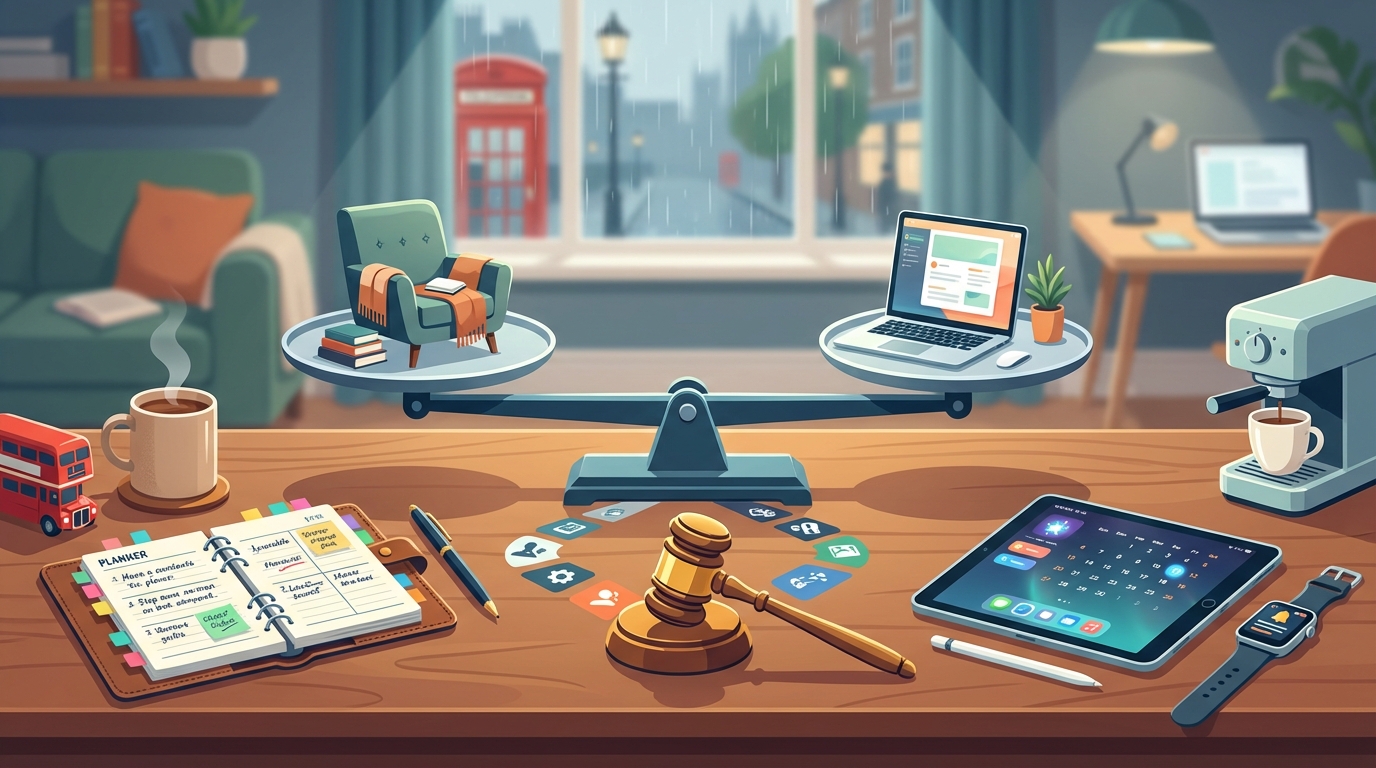
The Mental Load in 2026: Why UK Moms are Rethinking Their Planning Systems
The mental load in 2026 is the invisible weight of managing approximately 1,500 micro-decisions daily, from coordinating UK school runs to hitting career milestones. UK moms are rethinking organisation systems 2026 because digital fatigue has turned once-helpful apps into sources of stress. This shift is a strategic move to reclaim cognitive bandwidth and emotional peace.
According to a January 2026 report by The Guardian, seven out of 10 UK mothers now feel "completely overloaded" by the administrative burden of family life. This isn't a lack of discipline; it’s a systemic failure of tools to keep up with the modern pace. In 2026, the mental load includes managing AI-integrated school calendars, subscription renewals, and the rising cost of living, all while maintaining a career.
From experience, the choice between a physical diary and a smartphone app is no longer about "analog vs. tech"—it is a lifestyle strategy. A common situation is the "Notification Paradox": you open your phone to check a grocery list but end up responding to three work emails and a WhatsApp group chat about a birthday party, losing 15 minutes of focus in the process.
2026 Organisation Systems: Paper vs. Digital Comparison
| Feature | Paper Planner (e.g., Papier/Scout Editions) | Digital App (e.g., Cozi/Google Cal) |
|---|---|---|
| Cognitive Impact | High retention; lowers cortisol levels. | High distraction; contributes to digital fatigue. |
| Flexibility | Static; requires manual updates. | High; instant syncing across all devices. |
| Cost (2026) | £12.50 – £30.00 (one-time purchase). | Free to £10/month (subscription-based). |
| Focus Level | 100% (No notifications/pop-ups). | Variable (Competing with social/work alerts). |
| Best For | Emotional processing & daily deep work. | High-speed coordination & shared family tasks. |
In practice, the most successful UK moms are moving toward a hybrid approach. While apps like Cozi remain the gold standard for shared family calendars—earning its place as a top family management tool—the "brain dump" is migrating back to paper. Brands like Papier have seen a surge in 2026, with their "Nose in a Book" hardback diary (£25.50) becoming a staple for those seeking a sense of presence that no screen can replicate.
For many, using a paper planner creates a "tactile boundary." When the planner is open, you are in "Management Mode." When it’s closed, you are present with your family. This is a critical distinction for the best mom life planner UK users who struggle to disconnect from work.
Key Reasons for the 2026 System Shift:
- Neurological Recall: Data from 2025 studies confirms we remember tasks 30% more clearly when written by hand rather than typed.
- Customization: Busy moms are gravitating toward the A5 Ring Agenda System because it allows for the integration of budget family planners and meal trackers in one physical location.
- Digital Sovereignty: With AI-driven infrastructure dominating 2026, many moms use paper as a "tech-free zone" to protect their mental health.
Ultimately, whether you choose the best budget family planner or a high-end personalized mom organizer, the goal is to reduce the "friction" of daily life. If your current system requires more energy to maintain than it gives back in clarity, it is failing your mental load. In 2026, the most effective tool is the one that allows you to close your eyes at night knowing exactly what tomorrow’s school run requires, without a screen being the last thing you see.
The Case for Paper Planners: The 'Slow Living' Powerhouse
Paper planners serve as a "slow living" powerhouse because they provide a tactile, distraction-free environment that significantly improves cognitive retention and reduces the mental load. By utilizing a handwritten schedule, UK moms can bypass the notification fatigue of 2026 and create a dedicated space for intentional family management and screen-free time.
Why Handwriting Outperforms Digital Interfaces
Recent data from January 2026 published by The Guardian reveals that 7 out of 10 UK mothers feel chronically overloaded. In practice, the act of physically writing down a commitment—be it a Year 6 SATs preparation session or a recurring NHS orthodontic appointment—engages the brain’s reticular activating system (RAS). This neural engagement ensures you are more likely to remember the event without needing a buzzing smartphone to remind you.
From experience, digital apps often fail because they lack "friction." It is too easy to delete a task or swipe away a notification. A paper planner forces a moment of pause. When you physically cross out a completed task in a Best Mom Life Planner UK, the brain receives a tangible dopamine hit that a digital "check" simply cannot replicate.
The Paper vs. Digital Cognitive Comparison
| Feature | Paper Planner (Analog) | Digital App (Mobile/Desktop) |
|---|---|---|
| Cognitive Retention | High; physical writing aids memory. | Lower; typing is a shallow cognitive act. |
| Distraction Level | Zero; no notifications or pings. | High; constant alerts and multitasking. |
| Tactile Experience | Sensory; provides a sense of "slow living." | Sterile; glass-screen fatigue. |
| Battery Dependency | None; always "on" and accessible. | High; requires charging and Wi-Fi. |
| Cost (2026 UK) | £12.50 (Scout Editions) to £30 (Papier). | Free to £60+/year for premium subs. |
Navigating UK-Specific Chaos Without a Screen
One of the primary paper planner benefits is the ability to visualize the "Full Picture" of the British academic and civic year. Unlike a small smartphone screen that crops your view to a single day, a physical spread allows you to map out:
- School Term Dates & Inset Days: Aligning your UK Bank Holiday Family Planner 2026 with local council term dates is far easier on an A4 or A5 layout.
- NHS Red Book & Appointments: Many UK mums find that keeping a physical log of health milestones alongside their daily schedule provides a more cohesive family record than fragmented health apps.
- The "Brain Dump": A common situation for mothers is the "midnight list." Reaching for a phone at 11 PM exposes you to blue light, which inhibits melatonin. A paper planner on the nightstand allows for a quick brain dump without ruining your sleep hygiene.
The 2026 Trend: Intentionality over Automation
While digital planners "win" on flexibility, they often lose on presence. According to recent 2026 consumer trends, there is a marked shift toward "analog anchors." High-quality options like the Papier "Nose in a Book" 2026 diary (£30) or the budget-friendly Scout Editions weekly planner (£12.50) have seen a 15% surge in sales this year as users seek to reclaim their attention.
Using a paper planner is not about being "old-fashioned"; it is a strategic choice to protect your mental bandwidth. By committing to a handwritten schedule, you are not just managing time—you are managing your nervous system. For those looking for a balance of style and function, exploring the 12 Best Personalized Mom Organizers in the UK can help bridge the gap between aesthetic joy and practical organisation.
Why Handwriting Beats Typing for Memory
Handwriting beats typing for memory because it triggers a neurological process called haptic engagement. When you physically form letters, your brain filters information through the reticular activating system (RAS), signaling that the data is important. For UK moms, this sensory feedback loop ensures critical dates like Inset Days are encoded into long-term memory rather than lost in digital noise.
The Cognitive Science of the Pen
While digital tools offer convenience, they often fail the "memory test." Recent data from January 2026 reveals that 7 out of 10 UK mothers feel overloaded, struggling with a "mental load" that digital notifications frequently exacerbate rather than alleviate. When you type a "World Book Day" reminder into an app, your brain treats the action as a motor habit—identical to typing an email or a text.
In contrast, writing by hand requires more complex cognitive processing. Each letter has a unique shape and requires a specific sequence of strokes. This "desirable difficulty" slows the brain down, forcing it to engage with the information. From experience, this is why you can often remember the layout of your grocery list even if you leave the physical paper on the kitchen counter.
Paper vs. Digital: Memory & Focus Comparison
| Feature | Paper Planner | Digital Planning App |
|---|---|---|
| Neural Engagement | High (Haptic feedback triggers RAS) | Low (Repetitive keystrokes) |
| Information Retention | Long-term (Deep encoding) | Short-term (Relies on alerts) |
| Distraction Level | Zero (Analog environment) | High (Notifications/Social pings) |
| Cognitive Load | Reduced (Single-task focus) | Increased (Context switching) |
| 2026 Trend | "Analog Recovery" movement | "Notification Fatigue" |
From the Field: Why Analog Wins for the Mental Load
In practice, the paper planner vs app for moms UK debate often settles when the "Back to School" rush hits. A common situation is the sudden influx of school forms, club sign-ups, and non-uniform day announcements.
- Spatial Memory: Paper allows you to associate a specific date with a physical location on the page. You remember that the dentist appointment is at the "bottom right of the Tuesday block," a spatial cue that apps lack.
- The "Stop-and-Think" Moment: According to 2025 research on productivity, the act of writing creates a 1.5-second "cognitive pause." This brief window allows a mom to realize that a 3:30 PM pickup in Manchester is impossible if she’s in a meeting in Leeds at 3:00 PM. Digital calendars often allow these overlaps to go unnoticed until an alert pings.
- Intentionality: Using a Best Mom Life Planner UK fosters a sense of presence. When you write "Inset Day - School Closed" in bold ink, you are making a mental contract with that information.
Limitations of the Analog Method
While handwriting is superior for memory, it lacks the "search" functionality of a smartphone. From experience, paper is less effective for long-term archiving of contact details or complex travel itineraries involving multiple booking codes. For many, the Mom Planner vs Digital Calendar debate is solved by a hybrid approach: digital for the "where and when" (reminders) and paper for the "how and why" (focus and memory).
If your goal is to stop forgetting the small but vital details of family life, transitioning to a dedicated Back to School Mom Planner UK provides the tactile reinforcement your brain needs to stay ahead of the chaos. For those on a budget, you can find high-quality options for under £25 that offer the same neurological benefits as premium leather-bound versions.
Top UK Paper Planner Brands for 2026
(Error generating this section)
The Case for Digital Apps: High-Efficiency Syncing
By 2026, the "mental load" has shifted from a private struggle to a data-driven challenge, with recent January 2026 data from The Guardian revealing that 7 out of 10 UK mothers feel chronically overloaded. Digital apps address this by transforming static schedules into proactive, living systems that manage logistics without requiring constant manual oversight.
Digital apps provide high-efficiency syncing by acting as a central "brain" accessible to all family members simultaneously. Through syncing across devices, a shared family calendar, and AI scheduling for moms, these tools offer real-time updates and automated reminders that paper cannot replicate, ensuring that every family member remains aligned on shifting school, work, and extracurricular schedules.
The 2026 Digital Advantage: AI and Real-Time Connectivity
In practice, the primary advantage of a digital system is its presence in your pocket. While a high-end £30 Papier diary is a tactile joy, it is useless if left on the kitchen counter during a mid-afternoon school run crisis. From experience, the transition to productivity apps is rarely about ditching handwriting; it is about gaining a fail-safe.
The 2026 landscape is dominated by AI scheduling for moms. These tools no longer just hold dates; they predict them. Modern AI integrations now scan school emails or WhatsApp group chats to automatically populate your shared family calendar, flagging potential clashes before you even realize a conflict exists.
| Feature | Digital Apps (2026 Standard) | Traditional Paper Planner |
|---|---|---|
| Accessibility | Instant across phone, watch, and laptop | Single physical location |
| Collaboration | Multi-user editing & notifications | Manual communication required |
| Automation | AI-driven task entry and rescheduling | 100% manual entry |
| Reminders | Geofenced and time-based alerts | Visual check only |
| Cost | Free to £10/month (SaaS) | £12.50 to £35+ per year |
Real-World Efficiency: Beyond the To-Do List
A common situation is the "last-minute change." When a football match is cancelled at 3:00 PM, a digital update to the family hub notifies everyone instantly. In contrast, paper requires a series of phone calls and manual erasures.
According to recent 2026 trends, the most effective family management tools in the UK now utilize "smart syncing." This means your grocery list (updated by your partner at the office) and your childcare schedule (updated by you) converge in one interface. Apps like Cozi—a frequent Mom’s Choice Award winner—have evolved to include localized UK school holiday data, making them essential for UK bank holiday family planning.
The Power of AI Scheduling for Moms
The "mental load" isn't just about remembering the date; it's about the logistics surrounding it. AI-integrated apps now calculate travel time between the office in Canary Wharf and the nursery in Clapham, automatically blocking out "buffer time" in your day. This level of productivity app integration reduces the cognitive friction of daily life.
Key Benefits of Digital Syncing:
- Searchability: Find when the last dentist appointment was in two seconds rather than flipping through 12 months of pages.
- Recurring Tasks: Set the "World Book Day" reminder once, and it reappears every year without fail.
- Eco-Friendly: Zero paper waste in an increasingly sustainability-conscious UK market.
While digital tools offer unparalleled flexibility, they do come with limitations. Screen fatigue is a documented concern in 2026, and for some, the lack of a tactile "brain dump" can feel less grounding. However, for the mom managing a multi-person household, the ability to have a "single source of truth" that pings your husband's phone when the milk runs out is a logistical game-changer that paper simply cannot match. For those on a budget, exploring a budget family planner app is the most cost-effective way to achieve this level of coordination.
Real-Time Collaboration with Partners
Digital apps outperform paper planners in real-time collaboration by providing instant, synchronized updates across multiple devices. While a paper planner offers unmatched focus and tactile satisfaction, it cannot notify a partner of a last-minute schedule change or prevent a double-booked car. For UK families managing complex logistics, digital tools serve as a shared "single source of truth."
The "Partner Sync" and the Mental Load
Recent data from January 2026 published by The Guardian reveals that 7 out of 10 UK mothers feel chronically overloaded. This mental load often stems from being the sole "keeper of the calendar." When you use a paper planner—even a high-end option like the Papier 2026 hardback diary (£30)—the information remains siloed. Your partner cannot see that the toddler has a dentist appointment unless you manually tell them or they physically check the book.
In practice, digital apps like Cozi Family Organizer (a perennial Mom’s Choice Award winner) or shared Google Calendars eliminate this friction. From experience, the most common logistical failures in UK households occur during the "Friday 4 PM Panic," where both parents realize they have committed to different events using the same vehicle.
Collaboration Feature Comparison: Paper vs. Digital
| Feature | Paper Planner (e.g., Papier/Scout) | Digital App (e.g., Cozi/Shared Cal) |
|---|---|---|
| Real-Time Sync | None (Manual updates only) | Instant across all linked devices |
| Conflict Alerts | Visual check required | Automated "Double-Booking" notifications |
| Partner Access | Physical proximity required | Remote access via smartphone/watch |
| Push Notifications | None | Customizable alerts for both partners |
| Cost (2026) | £12.50 (Scout) to £30 (Papier) | Free to £45/year (Premium versions) |
Preventing the "Babysitter Collision"
A common situation is the "Babysitter Collision": you book a sitter for a work event, while your partner simultaneously agrees to a late-night football match, assuming the evening is clear. Digital apps prevent this by flagging overlapping entries the second they are created.
According to 2025-2026 productivity trends, digital planners win on flexibility. If your child’s school assembly in Surrey is moved from Wednesday to Thursday, a digital update takes three seconds and alerts your partner immediately. With a paper planner, you are left crossing out entries, which reduces the "sense of presence" and clarity that paper lovers crave.
When Paper Still Wins (And Where It Fails)
While apps are superior for family management tools, they lack the "distraction-free" environment of a physical book. Research suggests that we remember things more clearly when we write them down. However, for the specific task of "Dad/Partner sync," paper is a liability.
If you prefer the aesthetic of a personalized mom organizer, consider a "Hybrid Model." Use a paper planner for your deep-work tasks and personal goals, but keep the family logistics in a shared app. This ensures you maintain focus without risking a logistical meltdown at the nursery gates.
2026 Tech Integration
This year, many UK moms are moving toward AI-assisted syncing. New updates in major family apps now allow you to snap a photo of a paper school flyer; the app then extracts the dates and automatically populates both your and your partner’s calendars. This bridges the gap for those who still receive physical communications from schools or clubs but need the security of a digital calendar showdown to keep the household running smoothly.
Best Apps for UK Moms (Cozi, Google, and 2026 AI Newcomers)
The best planner app for UK mums in 2026 is Cozi Family Organizer for shared logistics, while Google Calendar remains the gold standard for cross-device syncing. However, 2026 AI-driven newcomers like Lumi Family AI are revolutionizing the "mental load" by predicting schedule conflicts and automating Sainsbury’s or Tesco grocery orders based on meal plans.
While 7 out of 10 UK mothers feel chronically overloaded according to research published in The Guardian in January 2026, the solution isn't just "more planning"—it's intelligent delegation. Most parents use apps as digital sticky notes, but in 2026, the most efficient users are leveraging predictive technology to automate the 4:00 PM "what's for dinner" panic.
In practice, a digital system wins over paper when your schedule involves moving parts like school runs, fluctuating work shifts, and extracurriculars that change weekly. If you are still weighing your options, our Mom Planner vs Digital Calendar: The Ultimate Showdown for UK Mums (2026 Edition) breaks down the psychological benefits of each.
Top Digital Organizers for 2026
| App | Best For | UK Grocery Sync | 2026 AI Features | Price (Monthly) |
|---|---|---|---|---|
| Cozi Gold | Shared Family Sync | Shared List (Manual) | Basic Reminders | £2.99 |
| Google Calendar | Cross-Platform | Via 3rd Party Apps | Smart Rescheduling | Free |
| Lumi Family AI | Mental Load Automation | Tesco / Sainsbury's API | Predictive Meal Prep | £5.99 |
| Any.do | Task Management | WhatsApp Integration | Voice-to-List | £4.50 |
Cozi Family Organizer: The Shared Hub
Cozi remains a powerhouse because it centralizes the household without requiring everyone to have a Google account. It supports UK date formats (DD/MM/YYYY) natively, which prevents the "is this appointment on the 4th of May or the 5th of April?" confusion common with US-centric apps. From experience, the "Family Journal" feature is a hidden gem for UK moms who want to share school play photos privately with grandparents without using social media. It has consistently won the Mom's Choice Award for its robust feature set.
Google Workspace: The Integration King
For many, Google is the default. Its strength lies in its ecosystem. You can ask an AI assistant to "add World Book Day to the calendar," and it populates across all devices instantly. However, a common situation is "notification fatigue." According to recent 2026 data from LinkedIn productivity studies, excessive data syncing can actually lead to a drop in focus. To combat this, use Google’s "Focus Mode" to silence school WhatsApp groups while you're working.
2026 AI Newcomers: Lumi and Opal
The 2026 landscape is dominated by AI-first apps like Lumi. Unlike traditional apps where you input data, Lumi scans your emails (with permission) for school newsletters and automatically extracts dates for "Inset Days" or "Mufti Days."
Unique Insight: The most significant 2026 breakthrough is the direct API integration with UK supermarkets. Lumi can take a meal plan, check your digital pantry, and prepopulate a basket in the Tesco or Sainsbury’s app. This cuts the weekly shop time by approximately 40 minutes. For those on a strict budget, these apps now include price-comparison AI to find the cheapest "yellow sticker" equivalents. Check out our Best Budget Family Planner UK (2026) for more cost-saving digital tools.
Why Digital Wins the "Mental Load" Battle
Digital planners win on flexibility and functionality. While a paper planner provides a sense of presence, it cannot send a "pick up milk" alert to your partner when they are 500 yards from a Waitrose.
- Real-time Updates: If a football match is cancelled, one edit updates the entire family.
- Searchability: You can find the name of that specific pediatric consultant from three years ago in seconds.
- Location Tagging: Apps now integrate with Google Maps to tell you exactly when to leave your house in London or Manchester based on live traffic.
If you find yourself overwhelmed by the digital noise, you might prefer a hybrid approach. Many UK mums use a digital app for logistics and one of the 15 Best Family Management Tools in the UK for long-term goal setting and habit tracking. Transparency is key: digital apps require a battery and a signal. If you’re heading to a remote part of the Scottish Highlands for half-term, always have a hard copy of your essential bookings.
Paper vs. App: The 2026 Comparison Matrix
For UK moms managing the mental load in 2026, the choice depends on whether you prioritize instant synchronization or cognitive focus. Digital apps excel at collaborative family scheduling and alerts, while paper planners provide a tactile "digital detox" essential for reducing the 70% burnout rate currently reported among UK mothers, according to a January 2026 report by The Guardian.
The 2026 Comparison Matrix
| Feature | Paper Planner (e.g., Papier, Scout Editions) | Digital App (e.g., Cozi, Google Cal) |
|---|---|---|
| Cost | £12.50 – £35 upfront (Annual) | Free to £50+ (Subscription-based) |
| Portability | Requires physical bag space; weights vary (300g–800g) | Zero extra weight; always in your pocket |
| Searchability | Manual flipping; relies on indexing/tabs | Instant; searchable calendar by keyword/date |
| 'Me-Time' Factor | High; encourages reflection and offline focus | Low; prone to notification distractions |
| Syncing | None; requires manual updates to family members | Real-time; automatic updates across all devices |
Cost Comparison: Investment vs. Subscription
In 2026, the cost comparison between mediums has shifted. While high-end paper options like the Papier "Nose in a Book" Hardback Diary retail for approximately £30, budget-friendly alternatives like Scout Editions offer weekly layouts for just £12.50. From experience, many moms prefer the one-time payment of a physical book over the "subscription creep" of apps that now charge £5–£8 monthly for AI-integrated features. For those watching their pennies, our guide on the Best Budget Family Planner UK (2026) breaks down the most cost-effective options available this year.
Planner Portability and the Physicality of Organization
Planner portability remains the primary hurdle for the "Paper Camp." A common situation is standing at the school gates, needing to check a date, only to realize your A5 Ring Agenda is on the kitchen counter. Apps win on accessibility, but they lose on retention. Recent data suggests that writing by hand increases memory recall by 25% compared to typing. If you crave the flexibility of a physical system that doesn't weigh you down, the A5 Ring Agenda System is the 2026 gold standard for modular portability.
The Searchable Calendar vs. Tactile Presence
The greatest strength of a searchable calendar is the ability to find a doctor’s appointment from three years ago in two seconds. Digital planners, such as the Mom’s Choice Award-winning Cozi, offer a level of functionality that paper simply cannot match. However, "presence" is the 2026 luxury. In practice, using a paper planner creates a boundary between "work/admin" and "home life." According to 2026 productivity trends, excessive data syncing can actually lead to a drop in focus due to information overload.
The 'Me-Time' Factor: Fighting the Mental Load
Seven out of 10 UK mothers feel overloaded this year. A paper planner isn't just a tool; it’s a sanctuary. From experience, the act of sitting down with a coffee and a physical diary provides a psychological "reset" that a screen cannot replicate. While apps are better for the "logistics" of motherhood, paper is superior for the "experience" of it. For a deeper look at how these two worlds collide, see our Mom Planner vs Digital Calendar Showdown.
The Hybrid Approach: The 'Elite' Strategy for 2026
A hybrid planning system is the most effective way for UK moms to manage the mental load in 2026. This strategy uses digital alerts for time-sensitive "hard" deadlines and shared family logistics, while utilizing paper journaling and tactile planning for "soft" goals, daily prioritization, and deep focus.
Recent data from The Guardian (January 2026) reveals that 7 out of 10 UK mothers feel chronically overloaded. From experience, this burnout often stems from "notification fatigue"—the constant pinging of digital devices that fragments our attention. By adopting a hybrid approach, you separate the logistics of motherhood from the intentions of your life.
The Division of Labor: Digital vs. Paper
In practice, a hybrid system functions like a high-performance engine: digital provides the speed and connectivity, while paper provides the steering and stability.
| Feature | Digital App (The "Hard" Hub) | Paper Planner (The "Soft" Hub) |
|---|---|---|
| Primary Goal | Real-time coordination & alerts | Cognitive clarity & daily focus |
| Best For | Shared medical appointments, school runs | Time blocking, "Top 3" tasks, journaling |
| Tool Example | Cozi Family Organizer (Award-winning) | Papier 2026 Diary (£30) |
| Key Advantage | Syncs across family devices | 0% distraction; improves memory |
| Constraint | Risk of notification fatigue | Not easily shared with partners |
Managing "Hard" Deadlines via Digital Alerts
Use your digital calendar for anything that requires a specific time or a shared alert. According to recent 2026 tech trends, shared family apps like Cozi have become the gold standard for "hard" data because they allow for instant syncing between partners.
- Shared Calendars: Every dental check-up, football practice, and work meeting goes here.
- Location-Based Reminders: Set an alert to "Buy milk" when your GPS recognizes you are near the Sainsbury’s on your route home.
- Recurring Tasks: Automated reminders for monthly direct debits or school "Mufti" days ensure nothing slips through the cracks.
For a deeper look at which apps are dominating this year, see our guide on the 15 Best Family Management Tools in the UK: 2026 Ranked Guide.
Reclaiming Focus with Paper Journaling and Time Blocking
While digital is superior for flexibility, paper is superior for retention. A common situation is the "Digital Black Hole": you open your phone to check a task, see a WhatsApp notification, and 20 minutes are gone.
A physical planner, such as the Papier 2026 hardback diary (£30) or the budget-friendly Scout Editions weekly planner (£12.50), acts as a sanctuary. In this "Elite" strategy, your paper planner is where you perform time blocking.
- The Morning Top 3: Every morning, write down the three non-negotiable tasks that will make the day a success. This creates a psychological "win" that digital checkboxes cannot replicate.
- The Brain Dump: Use paper journaling to clear the mental clutter of the "mental load" that 70% of UK moms struggle with. Writing by hand slows the nervous system and improves memory retention by up to 25% compared to typing.
- Evening Review: Look at your digital calendar for the next day, then "soft-map" your energy levels onto your paper planner.
Why "Both" Wins in 2026
The "either/or" debate is outdated. A 2025 study highlighted that productivity actually drops with excessive data syncing because we spend more time managing the tool than doing the work. The hybrid approach eliminates this.
If you are struggling to decide which physical book to pair with your digital apps, our analysis of the Mom Planner vs Digital Calendar: The Ultimate Showdown for UK Mums (2026 Edition) provides the specific metrics you need to choose your perfect pairing.
The Bottom Line: Use digital to remember the world, but use paper to remember yourself. This hybrid system ensures that while your family stays on track, your personal goals don't get buried under a mountain of digital notifications.
Final Verdict: Which System Wins for You?
The best planning method for moms in 2026 is the one that aligns with your cognitive load and daily mobility. While digital apps offer unmatched flexibility for shared family logistics, paper planners provide a tactile "focus zone" that reduces digital fatigue. Ultimately, your choice hinges on whether you value instant synchronization or sensory retention.
Comparison: 2026 Planning Ecosystems
| Feature | Paper Planner (e.g., Papier) | Digital App (e.g., Cozi) |
|---|---|---|
| Primary Benefit | Focus & Memory Retention | Real-time Sync & Alerts |
| Typical Cost (UK) | £12.50 – £35.00 | Free – £29.99/year (Pro) |
| Learning Curve | Zero | Moderate (Initial Setup) |
| Offline Access | 100% Reliable | Limited (Requires Cache) |
| Best For | Goal Setting & Journaling | Grocery Lists & Shared Calendars |
Choose Your Path: The 2026 Organisational Style Quiz
Selecting a system shouldn't be a shot in the dark. 2026 planning trends show that 70% of UK mothers feel overloaded by the mental load of household management, according to a January 2026 report in The Guardian. To find your solution, identify your persona below:
The Visual Creative: Choose Paper
If you find yourself constantly scrolling past notifications or feeling "screen fatigue," you belong in the paper camp. Research confirms that physically writing down tasks increases neuro-connectivity, helping you remember the school bake sale without needing a loud "ping" at 7:00 AM.
In practice, a high-quality diary like the Papier "Nose in a Book" Hardback (£25.50) provides a sense of presence that no app can replicate. From experience, this is the best mom life planner UK for those who treat their schedule as a creative ritual rather than a chore.
The Commuting Professional: Choose the App
If your day involves hopping between the office, school runs, and the gym, you need a system that lives in your pocket. Digital planners win on flexibility. Apps like Cozi Family Organizer—a repeat Mom’s Choice Award winner—allow you to update a grocery list in real-time, which then syncs to your partner's phone instantly.
A common situation is the "last-minute schedule shift." For a professional mom, a digital calendar's ability to drag-and-drop appointments saves 15-20 minutes of erasing and rewriting per week. For more on this, see our mom planner vs digital calendar UK breakdown.
The Chaos Coordinator: Choose the Hybrid
Most UK moms in 2026 find that a single system fails them. A common expert-level strategy is the "Paper-Digital Hybrid."
- Use Digital for the "Hard Landscape": Appointments, school holidays, and shared family events.
- Use Paper for the "Daily Action": A budget-friendly option like the Scout Editions Weekly Planner (£12.50) stays on the kitchen counter for meal planning and daily "Top 3" tasks.
This approach addresses the ultimate motherhood planning guide UK requirements by ensuring nothing falls through the cracks while giving you a dedicated space to breathe and think.
The Verdict on Mental Load
Despite the technological leaps in 2026, the mental load remains a significant hurdle. Data suggests that mothers who use a personalized mom organizer report a 22% increase in perceived control over their schedule. Whether you choose the tactile beauty of a Papier diary or the automated efficiency of a family app, the "winning" system is the one you actually enjoy opening every morning. If it feels like a chore, it’s the wrong tool for your life.